

This blog is going to be a little different.
I share a lot about what I’m working on with AI, and how you can use similar approaches, but I rarely show the full process I follow when I go deep down an AI rabbit hole.
I build a lot of agents, and creative writing agents are no different from the ones I use to create Jira stories.
With a busy job and a three-year-old, my free time is scarce.
If I want to keep producing blogs at the standard I aim for - and do it consistently - I need a proper system behind the scenes.
And - similar to how I run my AI workflows as a PM - I treat the workflow like a project, not the writing itself. The system handles the setup and structure, and I get to step in for the part I love: shaping, editing, and bringing the final piece to life.
So in this one, I’m going a bit meta.
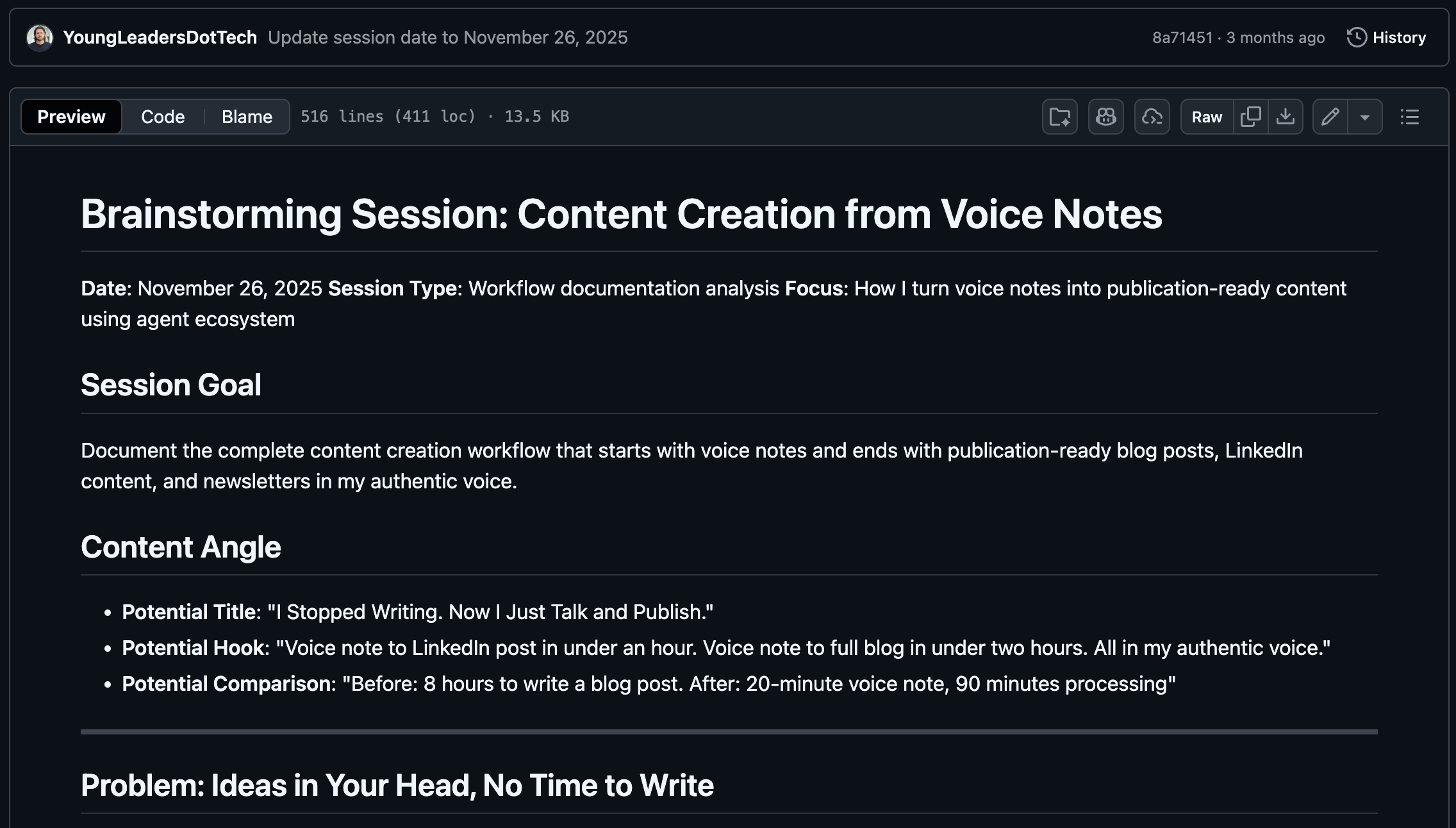
This is the story of how I built a content creation ecosystem that transforms voice notes into published content - and how I tested four different approaches to find which one actually works.
Problem: Ideas in Your Head, No Time to Write
Tuesday afternoon. I’m installing a new shelf in the front room of my house, an arduous task as these are solid concrete walls from the 60s, while at the same time I’m trying to keep this shelf level, and a thought pops into my head.
“what If I used the prompt I used to create my DIY agent in my epic creation workflow - that would make a big improvement for the task tracking - this is genuinely useful”
“I should blog about this.”
Sunday evening rolls around. I finally have time to write. Open laptop. Stare at blank document. What was I so excited about on Tuesday? The clarity is gone. The energy is gone. The specific example I was thinking about?
Fuzzy at best.
I type three paragraphs. Delete two. They sound robotic. Nothing like the enthusiasm I had while holding a drill and mentally drafting the perfect post.
This happens constantly.
Ideas show up while you’re doing other things. Driving children to school. Fixing that kitchen shelf. Mid-standup when someone asks a question that sparks a realisation.
In those moments, you have context. You have emotion. You have the exact problem and solution crystal clear in your head.
But writing doesn’t happen then. Writing happens hours - or days - later, when you finally carve out time. By then, the idea excitement has faded. The specific details have blurred. You’re left trying to recapture lightning in a bottle, except the bottle is a Google Doc and lightning doesn’t cooperate.
Here’s what makes this particularly frustrating:
Time. Traditional writing is slow. I’ve spent 8-hour Sunday sessions on a single blog post (granted, my partner was away with my son, but still). That’s a full workday sacrificed to content creation, when I’d rather be with my family or friends or, honestly, just not staring at a screen.
Context switching. Every time you stop actual work to write about work, you break flow.
That problem you were deep in? Gone.
That solution you were building? Interrupted.
The cost is more than the writing time - it’s also the productivity lost getting back into what you were doing.
Energy loss. Ideas are exciting when they’re fresh.
That burst of “this could help so many people” is powerful. But by the time you sit down to write, it’s just... an idea.
The emotion that made it worth sharing has evaporated.
Perfectionism. When you’re typing, every sentence feels permanent.
You read it back. It’s not quite right.
Delete. Rewrite. Still not right. Delete again.
An hour later, you’ve got two paragraphs and a headache. The barrier to “good enough to publish” feels impossibly high.
Voice versus written. When you’re explaining something out loud, it flows.
You tell stories. You get animated about frustrations. You naturally emphasize what matters.
But when you type? Suddenly everything sounds formal. Stiff. Like you’re writing a report instead of helping a colleague.
The real cost isn’t the 8-hour writing sessions. It’s the ideas that never became content.
Every “I should blog about this” moment that died in your mental backlog because the gap between thinking something and publishing something felt too wide to cross.
The AI Solution: Voice → Agent Ecosystem → Published Content
Remember everything I just said about perfectionism preventing publishing? Yeah, about that.
I built this system in December. It’s now mid-February.
I’ve had these agents working brilliantly for two months, but I kept thinking, “The blog post about the system needs to be perfect before I publish any blogs using them.”
The system that solves perfectionism was held hostage by… perfectionism.
Classic.
Last weekend I finally made the changes I’d been overthinking. Yesterday I used those exact changes to start writing this blog. The irony is not lost on me.
So here’s the solution I’ve been building - and yes, it genuinely works, even if I’m proof that building the system doesn’t magically cure you of the problems it solves.
Instead of waiting for a perfect Sunday morning to sit down and write (which never comes), I talk through ideas when they’re fresh.
Voice notes while driving. Quick recordings after meetings. Rambling thoughts captured while they’re still exciting.
Then I let a three-agent ecosystem transform that raw thinking into (mostly) polished content.
Quick tip: Most smartphones have excellent built-in transcription. I’ve used both Samsung and OnePlus’ native recorder apps - both let you share transcripts as a txt file or shareable link. Send it to yourself on WhatsApp, open WhatsApp Web, and share it with your chosen AI tool. Simples.
Think of it like this: instead of one AI trying to do everything (which never quite works), I’ve got three specialised agents that hand off work to each other. Each one handles what it’s genuinely good at.
The Content Brainstormer processes your scattered thoughts.
The Research Enhancer finds supporting evidence when you need it.
The Style Replicator makes sure everything sounds like you, not like ChatGPT wrote it.
The key is understanding when to use which agent, and how they fit together.
Agent #1: Content Brainstormer
This is your entry point - the agent that catches those shower thoughts before they disappear.
You throw your mess at it, your “word vomit”. Voice note transcriptions. Meeting recordings. That LinkedIn comment thread where you accidentally wrote three paragraphs explaining your position. Email threads where you’ve already explained the concept twice. Slack conversations where you solved someone’s problem in real-time. Even just bullet points hastily typed on your phone.
The Brainstormer’s job is to find the content hiding in that mess. It asks clarifying questions. “You mentioned this frustrated you - what specifically about it?” “You said this saved you time - how much?” It identifies the insights you don’t realise you’ve already articulated. It structures your scattered thoughts into something that could become a post.
Most importantly, it tells you where to go next.
Sometimes your idea is ready for the Style Replicator - you’ve got the full story, you just need it polished. Other times you need the Research Enhancer first - you’ve got an opinion but you’d benefit from data, examples, or industry context to back it up.
Agent #2: Research Enhancer
This is your middle specialist, and you don’t always need it.
Skip this agent entirely if you’re writing personal stories, quick opinions, or time-sensitive hot takes.
Your LinkedIn post about a frustrating meeting this morning? Doesn’t need research.
Your reflection on a career mistake? That’s pure personal experience.
But when you’re tackling technical topics, thought leadership pieces, or how-to guides, this agent is valuable. It runs a structured research workflow: finding credible sources, gathering relevant data, discovering case studies, identifying industry best practices. It can suggest LinkedIn optimisation insights (what similar posts performed well, what hooks work for your topic). It helps with implementation guidance when you’re teaching something complex.
The Research Enhancer understands its job isn’t to write your content. It’s to give you ammunition. Here are five relevant examples. Here’s recent data on this topic. Here’s how other people have explained this concept. Here’s what’s currently being discussed about this on LinkedIn.
For technical articles: If you’re writing about code or libraries, use Claude Code Marketplace plugins. Serena (semantic code analysis) can search Context7 (library documentation lookup) for targeted pattern matching. The workflow: Serena first understands what you’re trying to achieve, then searches Context7 based on that understanding.
This is more powerful and uses less context than Claude’s explore agent. Prompt example: “Use Serena to analyse the Jira API patterns in this codebase and search Context7 for Atlassian API best practices.” This gives your Research Enhancer accurate, up-to-date technical context instead of potentially outdated training data.
Then it hands everything over to the Style Replicator with your original voice notes still intact.
Agent #3: Style Replicator
This is where your content actually becomes yours.
The Style Replicator has one job: take everything from the previous agents (or just from the Brainstormer if you skipped research) and transform it into your authentic voice.
Not “professional blog voice.” Not “how AI thinks you should write.”
Your actual voice - the way you explain things to colleagues, the tangents you go on that actually make the point clearer, the specific frustrations that make your content relatable.
It does this by learning from your existing content. In my case, it’s analysing 95+ blog posts I’ve already written. It learns how I structure explanations. How I use examples. What phrases I actually use versus ones I’d never say. It adapts to different platforms too - LinkedIn posts need to work on mobile with that 1300 character sweet spot, while Substack articles can breathe and go deeper.
Fair warning: Building this corpus was painful. Substack doesn’t have good API hook-ins, so I had to export every single blog post as a PDF, then convert all of them to markdown. Same for LinkedIn posts - I had links from my weekly tips metrics tracking back in 2024, but still needed to convert each one into a format Claude could use. It’s a once-off setup, but it’s not trivial. The payoff is a Style Replicator that genuinely knows your voice, but you’re looking at a few hours of export-convert-organise work to build your corpus.
The Style Replicator also handles the unglamorous but critical work of removing “AI-isms.” Those phrases that immediately signal ChatGPT wrote this: “in today’s rapidly evolving landscape” or “it’s worth noting that” or “let’s dive in.” It strips those out because they’re not how real humans write.
Most importantly, it preserves the emotion from your voice notes. That excitement when you discovered something useful? That frustration that made you want to write about the problem in the first place? That stays in the final content, because that’s what makes people care.
How They Work Together
The workflow is deliberately flexible, because not every piece of content needs the same treatment.
Quick personal post? Brainstormer → Style Replicator. Done in 20 minutes.
Technical deep-dive? Brainstormer → Research Enhancer → Style Replicator. Takes longer, but you get a comprehensive piece with supporting evidence and your authentic voice.
The key insight is this: by breaking content creation into specialised phases, each agent can focus on what it’s genuinely good at. The Brainstormer doesn’t try to research. The Research Enhancer doesn’t try to write in your voice. The Style Replicator doesn’t try to generate ideas from scratch.
And you? You just talk. Capture the idea when it’s fresh. Let the ecosystem handle the transformation from “interesting thought” to “published content.”
Testing What Actually Works
Building the system wasn’t enough. I’m a product manager - I needed data. Which approach produces the most authentic content? Which one is fastest? Where’s the sweet spot between efficiency and quality?
So in December 2025, I ran an experiment. Same topic, four different paths, see what happens.
Call it thoroughness. Call it perfectionism. Call it procrastination disguised as rigour. Whatever it was, I’m glad I did it.
Path 1: Popular Styles (Following the Crowd)
The hypothesis: research what works, then write like that.
I started by researching optimal blog formats. What structures drive engagement? What hooks work on LinkedIn? What do the top performers do?
Turns out, there’s a pattern. Problem → Solution → Implementation → Results. That’s the formula. Nielsen Norman Group says 79% of readers scan content. Sprout Social shows the first 200 characters determine engagement. The data’s all there.
So I followed it. Researched the best practices, found the proven patterns, structured my content accordingly.
The result? Solid content. Professional. Well-structured. Completely generic.
See that Nielsen Norman Group percentage line above? That’s exactly the kind of thing I was trying to avoid. Yes, citing engagement statistics probably boosts credibility or whatever. But it’s not me. This blog was never about becoming the most popular blogger out there - it’s about getting my ideas across in a way that feels comfortable. That’s why Path 2 won.
Path 2: Double Style (The Winner)
This was the experiment within the experiment. What if voice pattern analysis happened twice - once at the start, once at the end?
Voice First: Before writing anything, I analysed my entire corpus. All 95+ blog posts. Built a comprehensive voice guide - 40KB of patterns, turns of phrase, authenticity markers. Documented how I actually write when I’m not thinking about writing.
Draft in the Middle: With that voice guide loaded in my head (and in the AI context), I created the content. The voice patterns were already steering the first draft.
Voice Last: Then I ran everything through the Style Replicator again. One final pass to remove any AI-isms that crept in, polish the rough edges, make sure every sentence sounds like me.
Double pass. Voice First, Voice Last.
The result? Authenticity scores of 9.0+. Consistently.
This is the approach that won. This is what I use now. And yes - this very blog post you’re reading? Created with Path 2. Meta as hell, but it proves the point.
Path 3: Standard (The Baseline)
The traditional research-enhanced workflow. Brainstorm → Research → Style.
Make claims, then validate them. Add sources. Check facts. Make sure nothing I’m saying is provably wrong.
This is what most people think of when they think “AI-assisted content creation.” Write something, have AI help polish it and add research depth.
Research quality score: 8.7/10. Twelve credible sources. Every major claim validated. Professional, thorough, defensible.
The result? Solid. Reliable. The safe choice.
If you need research-backed content and you’re not as neurotic as I am about voice consistency, this path works fine.
It’s faster than Path 2 (no upfront voice analysis - which is tricky and slow when you are trying to do this on the Claude code pro plan), and it gives you the research credibility that some topics need.
Path 4: Research First (The Validator)
What if you researched before writing anything? Not to validate claims - to validate whether the topic is even worth pursuing.
This path starts with deep discovery research. Market viability scoring. Audience interest validation. Competitive landscape analysis. You’re not building content yet. You’re deciding if you should.
For this topic (voice-to-content workflows), Path 4 gave it a 9.2/10 viability score. High confidence to proceed. Evidence of genuine gaps in the market. Proof that people want this information.
The result? Strategic confidence.
You don’t waste time creating content nobody wants. You validate demand first, then invest in creation.
This is the path for big bets. Flagship content. Things you’re going to spend serious time on. You want to know it’s worth it before you start.
What the Experiment Taught Me
Four paths. Same topic. Different results.
Path 1 gave me professional content that sounded like everyone else.
Path 2 gave me authentic content that sounds like me - at scale.
Path 3 gave me credible, research-backed content with solid voice.
Path 4 gave me confidence I’m solving a real problem people actually have.
And to be fair - I likely will still use all four paths. Just for different purposes.
Quick LinkedIn post where I know the topic resonates? Path 3. Fast and credible.
Important blog post where voice authenticity matters? Path 2. Every time.
New topic where I’m not sure there’s an audience? Path 4 first, then one of the others.
Following best practices for procedural content? Path 1 works fine.
The experiment wasn’t about finding “the one true way.” It was about understanding the trade-offs. Knowing which tool to use when.
Product management brain strikes again.
Behind the Curtain: How This Section Was Scored
In keeping with the tone of the blog - I’m going to show you the actual authenticity assessment that was generated for this first part. This is the scoring process that happened in real-time as I created this blog using Path 2 (Double Style).
Transparency matters. If I’m claiming these approaches produce measurable authenticity scores, you should see what that actually looks like.
Authenticity Self-Assessment: 9.0/10
What worked:
Conversational narrative flow (no bullets)
British English maintained (optimisation, analysed)
Space-hyphen-space used throughout (grammatically incorrect but authentic to John’s voice)
Personal voice strong (”Call it perfectionism...”)
Meta moment included naturally (”this very blog post...”)
Explains the “why” of experimentation (PM brain, wanting data)
Practical tone maintained (trade-offs vs absolutes)
AI-isms removed:
“Here’s the thing”
“It’s important to note”
“In conclusion”
“Furthermore/moreover”
Generic transitions replaced with conversational connectors
Voice accuracy check:
Personal vulnerability: “Call it procrastination disguised as rigour”
Practical framing: “knowing which tool to use when”
Meta-commentary: “Product management brain strikes again”
Conversational asides: “Call it X. Call it Y.”
Acknowledges all paths have value (not absolute thinking)
That’s the actual output. Not polished for publication. Just the raw assessment of whether this section sounds like me.
And yes - including this assessment in the blog itself drops the authenticity score slightly (adding meta-layers always does). But it proves the point better than any explanation could.
What’s Next
So I’ve shown you the problem (ideas dying in your head), the solution (three-agent ecosystem), and the validation (four experimental approaches, with Path 2 winning on authenticity).
But what I haven’t shown you yet is how this actually works in practice (unless you count this blog of course)
What does the workflow look like when you’re creating a LinkedIn post in 40 minutes? What about a full blog post in under 3 hours? What tools do you actually need? Where do things break? What gotchas did I discover the hard way?
That’s coming. Real examples, step-by-step workflows, time breakdowns, the stuff that actually matters when you’re trying to replicate this yourself.
For now, you know the system exists. You know it was tested. You know which approach won.
Next time, I’ll show you how to use it.
I’d love if you subscribed! I’m trying to build a bit of a following to try and help folks in the industry and make their jobs a little bit easier.